Application deadline: PASSED
Start date: BEST CANDIDATE ALREADY SELECTED
Duration: 4 years
Location: Department of Zoology, Charles University, Prague, Czech Republic, EU
Research group: https://www.fishevo.com/
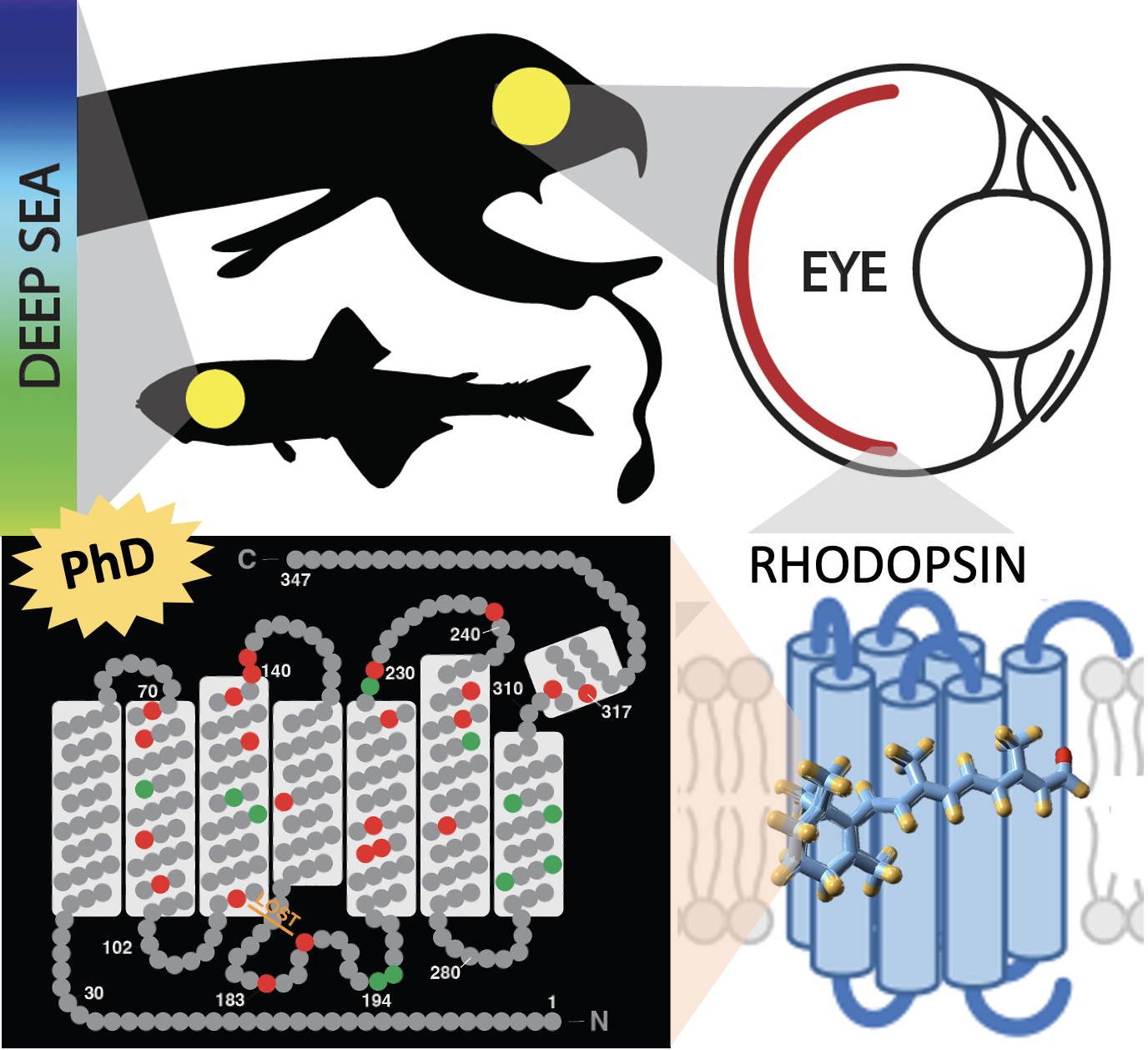
We look for candidates to join our research team (Fish Evolution research group) to become part of the ERC project “SensingDEEP: deep-sea fish vision pushing limits of the vertebrate eye”. The project is focused mainly on evolutionary genomics and transcriptomics of the deep-sea fishes to understand extreme adaptations of vision in the depth. The PhD student will be focused on the rhodopsin protein function, trying to reveal the genotype-phenotype link for visual pigments – we aim to combine fish & gene evolution with functional protein experiments. We always try to see all molecular and protein adaptations in the evolutionary context of the deep sea.
Tentative title of the PhD project: Fish vision in the context of rhodopsin evolution: deep-sea and other extremes.
We offer:
– an international research group with the ERC funding located in an inspiring historical city
– a competitive salary sufficient to live in Prague
– possibility to participate at international conferences and short-term visits during collaborations
– wide selection of courses at the Faculty of Science
We seek:
– a candidate with motivation and enthusiasm for biology, nature and science, and with ability and willingness to learn new approaches
– fluency in English
– a M.Sc. degree in biology or related fields (or to be finished by September 2025). We are flexible in “required” background of the candidate: from evolutionary biologist (willing to expand into protein function) to structural biologist (adding an evolutionary context)
– experience with laboratory techniques & protocols; in addition – experience with working with cell cultures will be considered as beneficial
The project:
Broader context: Deep-sea fish have evolved extreme adaptations to their environment. Such as in their eyes with cone and rod cells responsible for photoreception. In several deep-sea fish lineages, a novel visual system with unknown mechanism has been discovered (https://www.science.org/doi/full/10.1126/science.aav4632). Some species use multiple rhodopsins or have uncertain identity of the cones and rods, something very unusual for vertebrates. The main goal of this project funded by the ERC Consolidator grant is to study these adaptations from a single-cell level perspective, as well as to get hands on the deep-sea-fish unusual rhodopsin protein function. We have already covered most of the molecular angles (genetic, transcriptomic and single-cell transcriptomic), for which we have state-of-the-art genomic tools. The prospective PhD candidate should join our team and advance with stories about what the rhodopsins can actually do. While the focus of our research is mainly on molecular evolution, we generally aim to interpret cool stories out of our findings mainly in the context of the evolution, fishes and their life. The candidate is expected to present his/her project at international conferences and will be authoring research publications. All nations applicable.
All questions and applications (CV + half-page motivation letter + contact details for two persons who can be asked for a reference) should be sent directly to Zuzana Musilova (zuzmus[AT]gmail.com or zuzana.musilova[AT]natur.cuni.cz). Shortlisted candidates will be invited for a zoom call where we can discuss more details.
THANK YOU FOR YOUR APPLICATION:-)